OPRA Study Strategy for Overseas Pharmacists
Learn an effective OPRA study strategy for overseas-trained pharmacists, including therapeutics, mock exams, calculations, clinical reasoning, revision methods, and common preparation mistakes.
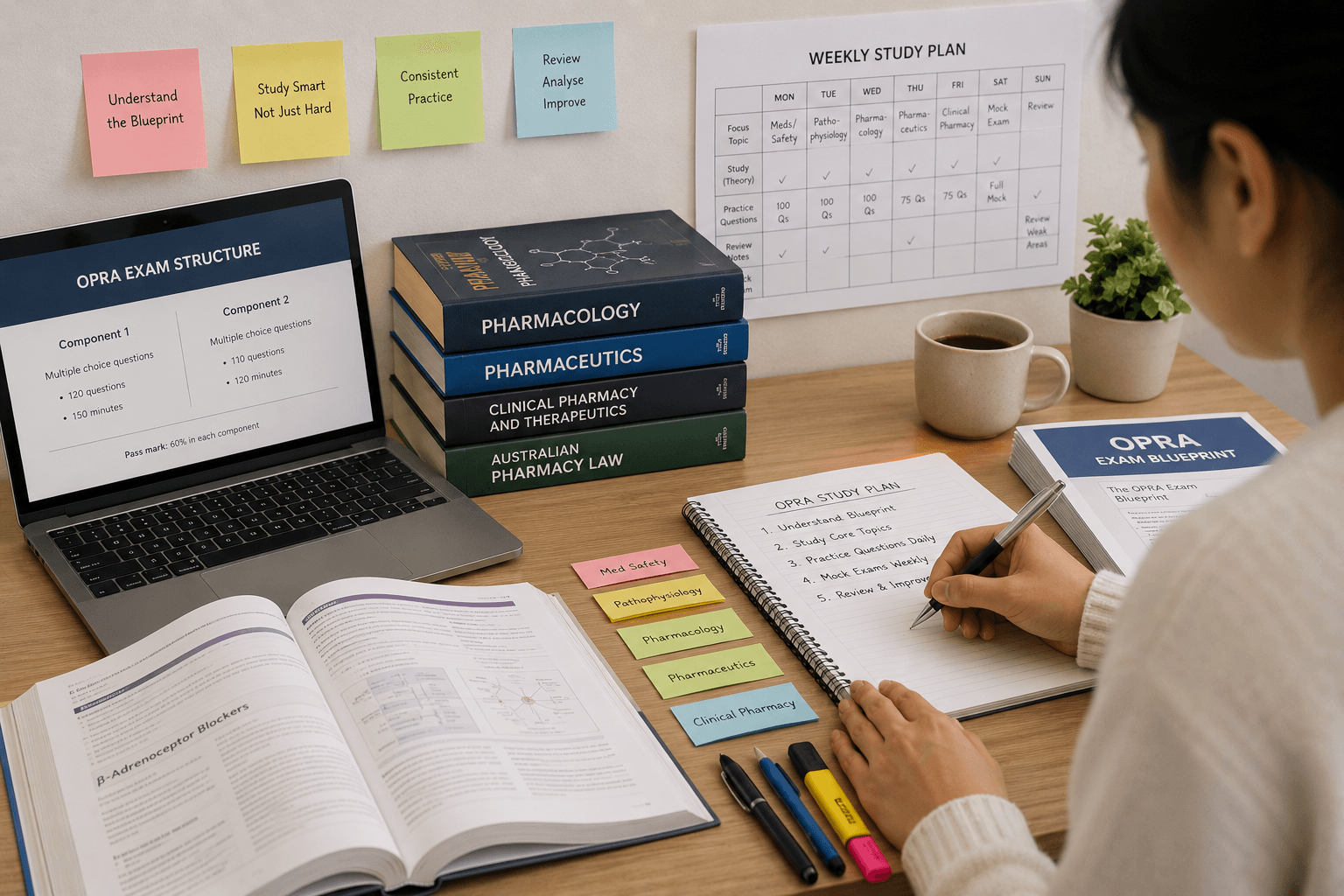
There's a version of OPRA preparation that feels productive but doesn't work particularly well. It looks like this: reading through textbooks systematically, highlighting important passages, building detailed notes, watching video lectures, and steadily working through a long list of topics until everything has been "covered."
Many candidates do exactly this — for months — and then find the exam harder than they expected. Not because they didn't put in the hours, but because the way they prepared didn't match what the exam actually tests.
OPRA is not primarily a knowledge test. It's a reasoning test. And that distinction changes almost everything about how you should prepare for it.
This article provides general guidance only. Official OPRA requirements are set by the Australian Pharmacy Council (APC). Always verify current details directly with the APC.
What OPRA Is Actually Measuring
Before deciding how to study, it's worth being clear about what you're being assessed on.
OPRA is designed to determine whether you're ready to enter supervised pharmacy practice in Australia. That means the exam is built around the thinking required in real pharmacy contexts — interpreting patient scenarios, identifying the safest course of action, applying therapeutic knowledge to specific clinical situations, and making decisions under time pressure.
The questions are multiple-choice, but they're constructed to reward reasoning, not recall. A question might describe a patient's presentation, their current medications, their relevant history, and their symptoms — and ask you to identify the most appropriate response. Getting that right requires you to weigh several factors simultaneously and arrive at a safe, evidence-based conclusion. Knowing that a drug exists isn't enough. You need to know when to use it, when not to, what to monitor, and what the patient needs to understand.
This is why candidates who prepare through memorisation alone often feel surprised by how the exam feels, even when they've studied extensively.
The Core Shift in Mindset
Most overseas pharmacists trained in systems that reward detailed theoretical knowledge and precise recall. OPRA rewards something different: the ability to reason clearly through clinical scenarios and arrive at safe decisions efficiently.
Making that shift is the real challenge of OPRA preparation — and it's one that takes deliberate, specific practice to develop. You can't think your way into it through passive content consumption. You develop it by doing: working through questions, analysing why answers are right or wrong, recognising patterns across cases, and gradually internalising the reasoning framework the exam is built around.
If you've ever finished a study session feeling like you covered a lot of ground but aren't sure you've actually improved your ability to answer questions — that's the gap this section is addressing.
The Five Areas Your Preparation Needs to Cover
Therapeutics
This is the single most important content area in OPRA, and it's the one most candidates wish they'd spent more time on.
The scope is broad — common disease states, first-line and second-line therapies, contraindications, adverse effects, drug interactions, monitoring requirements, and patient counselling. But the depth required isn't about memorising every detail of every drug. It's about understanding how therapeutic decisions are made: what makes one option safer than another for a particular patient, what signs suggest a therapy isn't working, what a patient needs to know to use their medication safely.
A useful way to frame your therapeutics study: don't just ask "what treats this condition?" Ask "what would I actually do for this patient, and why?"
Clinical Reasoning
This is where preparation either works or it doesn't. Clinical reasoning isn't a subject you can study — it's a skill you develop through practice.
The practical method is question-based learning. Work through practice questions, but don't just check whether you got the answer right. For every question, understand the reasoning behind the correct answer and, just as importantly, understand why each incorrect option is wrong. Over time, you start to recognise the patterns the exam uses — the clinical red flags that point toward one answer, the subtle details that eliminate another.
Strong candidates also develop a systematic approach to eliminating options. OPRA questions often have one clearly unsafe answer, one that's reasonable but not optimal, one that applies to a different patient type, and one that's actually correct. Learning to work through that hierarchy efficiently is a skill worth developing explicitly.
Calculations
Calculations are often underestimated in preparation and then disproportionately stressful on exam day. The content isn't usually complicated — but accuracy under time pressure is a different thing from accuracy when you're relaxed and working slowly.
Practise calculations consistently throughout your preparation, and always practise them timed. The goal is to reach a point where your method is automatic enough that you don't have to think about the process — just the numbers.
Exam Technique
This matters more than candidates typically account for. OPRA gives you 150 minutes for 120 questions — roughly 75 seconds per question. That's workable, but it requires disciplined pacing. Candidates who haven't practised under real time constraints often find themselves spending too long on difficult questions, running short on time, and making rushed decisions at the end.
Good exam technique includes: moving on from questions you can't answer quickly and returning to them, resisting the urge to over-analyse straightforward questions, and not changing your first answer unless you have a clear reason to. These habits are developed through practice, not intuition.
Mock Exams
Timed, full-length mock exams are probably the highest-value preparation activity available to you, and they're also the one most commonly skipped or treated as optional.
Mock exams do several things that nothing else does: they build the stamina required to sustain concentration for 2.5 hours, they surface weaknesses you didn't know you had, they reveal whether your pacing is realistic, and they habituate you to working under the pressure of a ticking clock. Candidates who have done multiple realistic mock exams before sitting OPRA almost universally report feeling better prepared — not just knowledgeable, but settled.
Don't save mock exams for the final week of preparation. Introduce them earlier, when there's still time to address what they reveal.
Study Mistakes Worth Knowing About
Passive reviewing. Reading through notes or watching lectures creates a feeling of familiarity that can be mistaken for understanding. The test of real understanding is whether you can apply the knowledge to a question you haven't seen before. If your study sessions don't regularly involve that kind of active application, they're probably less effective than they feel.
Delaying question practice. Many candidates wait until they feel "ready" before attempting practice questions. In practice, questions are what create readiness. Start them early, when you'll get many wrong — that's precisely when they're most useful.
Trying to cover everything equally. OPRA is broad, and attempting to master every topic to the same depth is both impossible and unnecessary. High-yield therapeutics, clinical reasoning, and calculations deserve the most attention. Some content areas contribute very little to exam performance relative to the time they consume.
Ignoring weak areas. It's natural to gravitate toward topics you already know well — they feel productive to study. But your exam performance will be shaped more by your weakest areas than your strongest ones. Identifying gaps early and addressing them deliberately is more effective than reinforcing existing strengths.
Studying without simulating exam conditions. If you've never worked through questions under a strict time limit, in a quiet environment, without the option to pause and look things up, you haven't fully prepared for what the experience of sitting OPRA actually feels like.
How Long Should You Prepare?
There's no answer that applies to everyone, because preparation time depends on your clinical background, how recently you graduated, your English proficiency, how many hours per week you can realistically study, and how efficiently you prepare.
What most successful candidates have in common isn't a specific number of months — it's consistency. Four to six months of focused, structured preparation tends to be a reasonable baseline for candidates studying full-time. Six to twelve months is common for those preparing part-time alongside work. But a candidate who studies with real focus for four months will typically outperform one who studies loosely for eight.
The preparation approach matters more than the preparation length.
On Mental Load and Sustainability
This is worth addressing directly, because it's something many candidates don't talk about enough.
A significant number of people preparing for OPRA are doing so while working, managing family responsibilities, navigating visa uncertainty, dealing with financial pressure, and processing the stress of a major life transition simultaneously. That's a lot to carry alongside an exam that requires consistent mental effort over several months.
Burnout is a real risk. Studying intensively for a few weeks and then being unable to maintain any momentum is a common pattern, and it's less effective than a slower but more sustainable pace kept up over a longer period.
A preparation strategy that you can actually maintain — with proper rest, realistic daily targets, and some flexibility built in — will almost always outperform one that looks impressive on paper but collapses under the weight of real life.
What the Best-Prepared Candidates Do Differently
Looking at candidates who perform well in OPRA, a few habits stand out consistently. They start practising questions early rather than waiting until they feel ready. They treat mock exams seriously rather than as a formality. They spend disproportionate time on therapeutics because they understand that's where the exam rewards depth. They develop a clear method for working through questions rather than approaching each one from scratch. And they build preparation around consistency rather than occasional intensive effort.
Perhaps most importantly — they learn to think like the exam. That sounds abstract, but it's concrete in practice: they understand what the exam is trying to assess, they recognise the patterns in how questions are constructed, and they've practised enough to apply their knowledge efficiently rather than just possessing it.
Choosing How to Prepare
Some candidates self-study successfully using official resources, textbooks, and independently sourced practice questions. Others benefit from structured courses, guided revision programs, mock papers with detailed feedback, or accountability systems that help them maintain consistency.
Neither approach is inherently better. The best method is the one that you'll actually execute consistently over the full preparation period. What doesn't work is an approach that's theoretically comprehensive but falls apart in practice — too expensive to sustain, too intensive to maintain alongside work, or built around content consumption without enough active application.
Be honest with yourself about what your preparation actually needs, and build a strategy around that rather than around what seems most thorough in theory.